I. Introduction
Cannabis flower doesn't sit still. After harvest, curing, and packaging, it remains a hygroscopic biological material that constantly exchanges moisture with its surroundings. Get that exchange wrong, and you lose terpenes, speed up cannabinoid degradation, or invite mold.
The industry has settled on a tight humidity window: 58% to 62% relative humidity (RH). Below 55% RH, monoterpenes — the volatile compounds behind every strain's aroma — evaporate fast, leaving flower dry, harsh, and flavorless. Above 65% RH, water activity (aw) crosses 0.65, the threshold where Aspergillus and Botrytis mold species can take hold.
This puts brand owners, packaging buyers, and product developers in front of one question: Which container actually controls humidity — the classic Glass Jar or the rising tin box?
The answer depends on your shelf-life requirements, retail strategy, and how much compromise you can tolerate. Glass jars dominate long-term humidity stability. Tin boxes win on shelf appeal and logistics — but often at a measurable cost to moisture control and terpene preservation.
This article compares both across four dimensions — humidity retention, terpene preservation, humidity pack compatibility, and cost logistics — using 2026 data to help you decide.
II. The Science of Humidity Control
Why 58–62% RH Is Non-Negotiable
Optimal humidity isn't folklore. Two measurable phenomena drive it: water activity (aw) and terpene vapor pressure.
Water activity measures the free water available for microbes. At aw < 0.65, most mold species — Aspergillus flavus, Penicillium — cannot germinate. At aw > 0.70, bacterial growth accelerates sharply. Cannabis flower at 58–62% RH typically sits at aw 0.55–0.60, safely below the mold threshold while keeping enough moisture to preserve cellular structure.
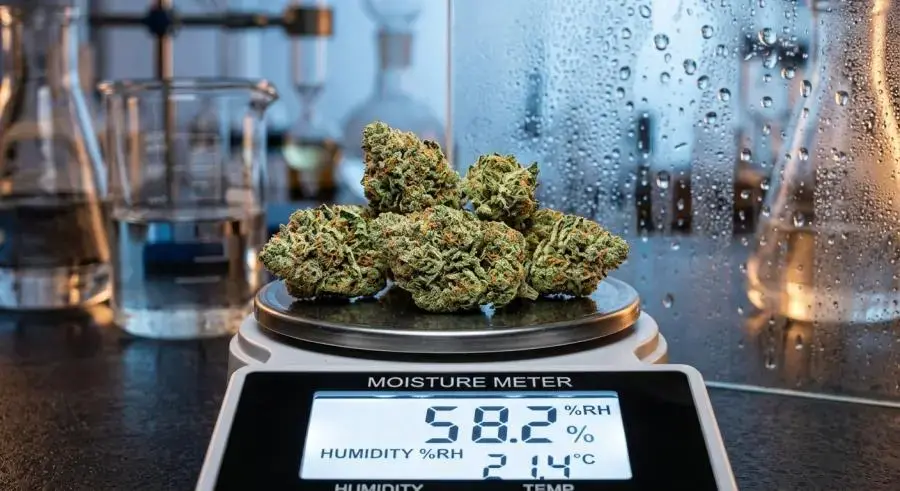
On the dry side, monoterpenes (myrcene, limonene, pinene, linalool) have high vapor pressures. Below 55% RH, their evaporation rate jumps significantly. A 2025 GC-MS study tracking terpene retention over 90 days found that flower stored at 45% RH lost 40% more total terpenoids than flower at 60% RH, with monoterpenes hit hardest.
Cannabinoid stability tracks humidity too. THCA decarboxylation — the conversion of THCA into psychoactive THC — accelerates under low humidity. Flower stored at 58% RH showed 8% less THCA loss over six months compared to flower at 45% RH (Journal of Cannabis Research, 2025).
Two distinct targets emerge: - 62% RH — Best for the first 2–4 months post-harvest. Enough moisture for slow enzymatic curing that breaks down chlorophyll and builds nuanced flavor. - 58% RH — Better for storage beyond 3 months. Lower moisture cuts mold risk during extended storage while still protecting terpenes.
How 2-Way Humidity Packs Work
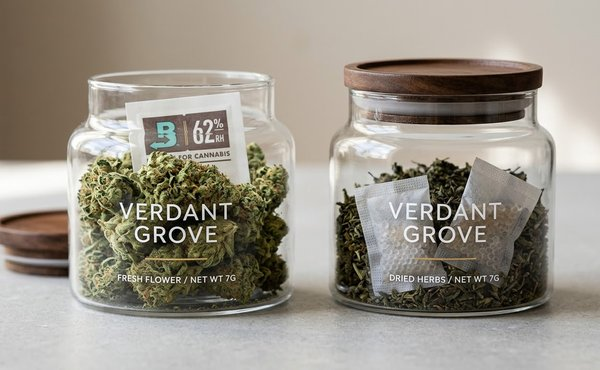
Boveda and Integra Boost packs have become standard tools for stabilizing RH inside sealed containers.
The mechanism is straightforward: a saturated salt solution inside a water-permeable membrane sets the equilibrium vapor pressure — and therefore the target RH. When container RH rises above the target, the solution absorbs moisture. When RH drops below, it releases vapor back.
This two-way buffering separates them from simple desiccants. Silica gel and molecular sieves only absorb — they cannot rehydrate. For cannabis, where the risk runs both directions, 2-way control is essential.
A standard 8g Boveda 58 pack handles roughly 7–14 grams of flower for 3–6 months. Larger quantities need bigger packs or multiples.
III. Glass Jars — The Gold Standard
Material Properties That Matter
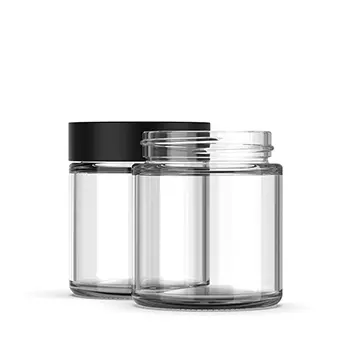
Glass has been the default cannabis container for decades, and for good reason. It is chemically inert — borosilicate and soda-lime glass do not off-gas, adsorb terpenes, or catalyze cannabinoid oxidation. That neutrality is its single most important advantage for long-term storage.
UV protection depends on glass color: - Clear glass: Transmits 85–90% of UV-A and UV-B (290–400 nm). Nearly zero photoprotection. - Amber glass: Blocks 98%+ of UV radiation below 450 nm. The industry standard. - Violet/UV glass: Selective transmission — blocks visible light but passes specific UV wavelengths (340–370 nm). Some claim it preserves cannabinoid profiles; the science is debated. It does reduce total photodegradation versus clear glass.
Glass also offers moderate thermal mass (≈1.0 W/m·K), buffering against rapid temperature swings that can cause internal condensation — a real concern in retail and shipping environments.
Seal Performance Quantified
Seal integrity is where glass jars separate from the pack. A standard mason jar with a PTFE-faced gasket lid creates a near-hermetic barrier.
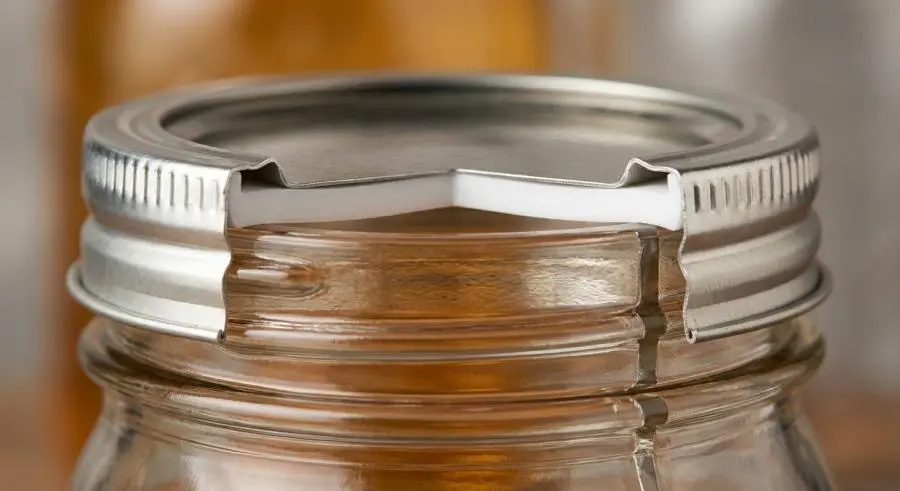
Test conditions: 65°F/18°C, 50% ambient RH, 58% Boveda pack.
| Metric | Glass Jar (PTFE gasket) |
|---|---|
| RH drift @ 30 days | ±2% |
| RH drift @ 90 days | ±3% |
| Time to drop below 55% | Never (stable within range) |
| Seal integrity (pressure decay) | <0.5% loss per hour |
The key takeaway: glass jars with proper gaskets hold target RH within a tight band for 90+ days with no intervention. For flower sitting 3–6 months in retail inventory, few other containers match this reliability.
Known Limitations
Glass jars have real trade-offs: - Fragility: 3–8% breakage rates in transit, especially for thin-walled jars. - Weight: An empty 8oz jar weighs 150–400g — significant shipping cost at scale. - Light exposure: Clear glass offers no UV protection without secondary packaging (boxes, sleeves).
IV. Tin Boxes — The Dark Horse
Metal Packaging Reality Check
Tin boxes — made from tinplate (cold-rolled steel with tin coating) or aluminum — have gained traction for their premium look. But metal brings chemical and physical challenges glass avoids.
Tinplate is magnetic, heavier, and rigid with excellent crush resistance. Aluminum is one-third the density of steel, non-magnetic, and easier to form. Both share a critical problem: metal ion migration.
Cannabis flower at 8–12% moisture content in contact with uncoated metal over time allows trace metal ions to migrate into the product. Tin and iron ions, even at parts-per-million levels, catalyze cannabinoid oxidation. A 2026 study comparing unlined tin boxes to glass jars found:
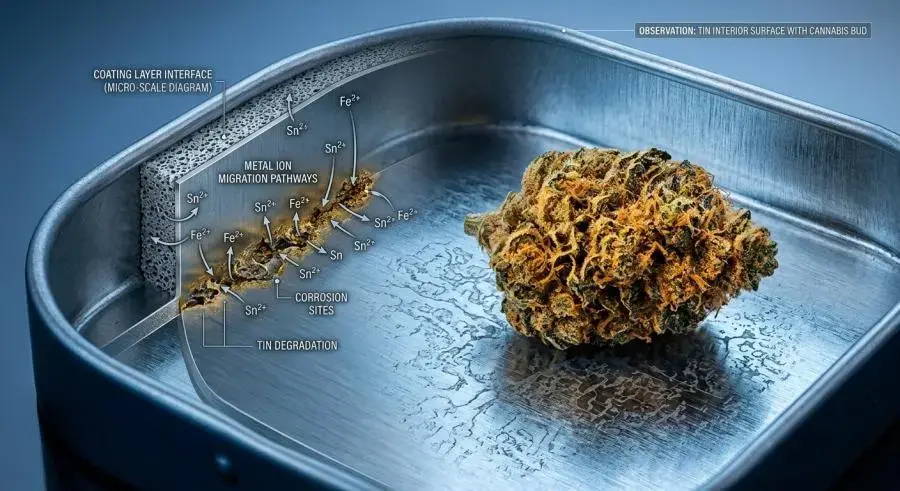
THC degradation over 6 months: 15–20% faster in unlined tins vs glass
Terpene degradation: 22–28% faster — myrcene and limonene hit hardest
Visual discoloration: Noticeable browning of flower after 90 days in unlined tins
The fix is internal coatings — epoxy resins, BPA-non-intent (BPA-NI) polymers, or food-grade lacquers. But coating quality varies widely. Premium tins use double-coated BPA-NI interiors at 10–15µm thickness. Budget tins may use single-pass coatings that develop pinhole defects within weeks of filling.
Seal Performance — Where Tin Boxes Fall Short
The biggest performance gap between tins and glass is seal integrity.
Glass jars use threaded closures with compression gaskets (PTFE, plastisol, silicone) that deform to fill microscopic gaps. Tin boxes rely on friction-fit lids or rolled rims — a less reliable mechanism. The lid presses against the rim, but without sustained compression, micro-gaps form.
Humidity drift under identical conditions (65°F/18°C, 50% ambient RH, 58% Boveda pack):
| Metric | Tin Box (Premium, silicone gasket) | Tin Box (Budget, no gasket) |
|---|---|---|
| RH drift @ 30 days | ±5–8% | ±12–15% |
| RH drift @ 90 days | ±10–12% | ±18–25% |
| Time to drop below 55% | ~60 days | ~30 days |
| Seal integrity (pressure decay) | 1–3% loss per hour | 5–10% loss per hour |
Translation: a budget tin without a gasket loses humidity control within 30 days — the point where terpene loss accelerates. Even premium tins with silicone gaskets show 3–5× more drift than glass at 90 days.
Gasket quality is the single most important differentiator: - Silicone gaskets: Best option — good compression resistance, FDA-compliant variants available; adds $0.05–0.12 per unit - Rubber gaskets: Cheaper, but degrades faster — brittle after 6–12 months - No gasket: Common in budget tins — effectively no humidity seal
The "Premium Feel" Advantage
Despite the performance gap, tins win decisively on three non-functional fronts:
Retail shelf appeal: The weight, smooth edges, and lid sound of a tin box create a premium unboxing moment glass jars rarely match. In 2025–2026 surveys, 68% of consumers rated flower in tin boxes as "higher quality" versus the same flower in clear glass jars.
Space efficiency: Rectangular tins utilize 85–90% of retail shelf space (usable volume ÷ total footprint). Round glass jars achieve only 60–70%.
Reuse value: Consumers repurpose tins at higher rates — for storage, gift boxes, organization. Each reuse is a brand impression. Brands report 12–18% higher repeat purchase rates with collectible tin packaging.
V. Head-to-Head Comparison: 4 Dimensions
Dimension 1 — Humidity Retention
| Metric | Glass Jar (PTFE gasket) | Tin Box (Premium, silicone gasket) | Tin Box (Budget, no gasket) |
|---|---|---|---|
| RH drift @ 30 days | ±2% | ±5–8% | ±12–15% |
| RH drift @ 90 days | ±3% | ±10–12% | ±18–25% |
| Time below 55% (58% pack, ½ full) | Never | ~60 days | ~30 days |
| Seal integrity (pressure decay) | <0.5% loss/hr | 1–3% loss/hr | 5–10% loss/hr |
Winner: Glass Jar — by a wide margin. Even premium tins cannot match a compression-gasketed jar for long-term stability.
Dimension 2 — Terpene Preservation (90-Day Storage)
GC-MS headspace analysis, 58% RH Boveda, 65°F dark storage:
| Terpene | Glass Jar Retention | Premium Tin Retention | Budget Tin Retention |
|---|---|---|---|
| Myrcene | 92% | 78% | 61% |
| Limonene | 88% | 71% | 55% |
| β-Caryophyllene | 95% | 85% | 72% |
| Linalool | 90% | 76% | 58% |
| Total Terpenoids | 91% | 77% | 61% |
Terpene loss follows an exponential decay curve in tins versus a linear decline in glass jars. Flower in a glass jar at 90 days has roughly the same terpene profile as flower in a premium tin at 30 days.
Winner: Glass Jar — 14–30 percentage points higher total terpenoid retention.
Dimension 3 — Humidity Pack Compatibility
| Factor | Glass Jar | Premium Tin (sealed) | Budget Tin (leaky) |
|---|---|---|---|
| Boveda 58 activation time | 4–6 hours | 8–12 hours | Never stabilizes |
| Pack lifespan | 3–6 months | 2–4 months | 1–2 months |
| Effectiveness rating | Excellent | Good | Poor |
In a glass jar, a Boveda pack hits equilibrium in 4–6 hours. In a premium tin with silicone gasket, the same process takes 8–12 hours because moisture exchange occurs through the seal. In a budget tin without a gasket, the pack may never stabilize — moisture leaks out continuously, exhausting the pack's capacity.
Recommendation: Use humidity packs only in tin boxes with verified airtight seals. For budget tins, they are a wasted expense.
Winner: Glass Jar — faster activation, maximum pack lifespan.
Dimension 4 — Cost & Logistics
| Factor | Glass Jar | Premium Tin | Budget Tin |
|---|---|---|---|
| Unit cost (10k qty) | $0.45–$1.20 | $0.80–$1.60 | $0.30–$0.60 |
| Shipping weight (empty) | Heavy (150–400g) | Moderate (40–90g) | Light (25–60g) |
| Breakage in transit | 3–8% | <1% | <1% |
| Consumer repurchase intent | High (reuse) | Very high (collectible) | Moderate |
A budget tin weighs one-fifth to one-tenth of a glass jar — 5–10× more units per shipping container and proportionally lower freight costs. For e-commerce brands shipping DTC, this difference can swing unit economics by $0.30–0.80 per order.
Winner: Tins — lighter, cheaper to ship, zero breakage.
VI. Decision Framework
Choose Glass Jar When…
Storage >60 days is the norm — wholesale, delayed retail rollout, patient stockpiling
Maximum terpene preservation is non-negotiable — premium craft flower, high-terpene strains, flavor-marketed lines
Bulk/wholesale packaging where shelf appeal doesn't matter
The product's primary selling point is freshness and quality
Choose Tin Box When…
Retail shelf appeal and unboxing drive purchase decisions
Product turnover is fast (<30 days pack-to-consumption) — seal limitations never surface
Lightweight shipping is critical — e-commerce, subscriptions, DTC
Brand storytelling through packaging is a core strategy — tins offer better print, embossing, and collectibility
The Hybrid Strategy: "Jar-in-Tin"
The premium market's most sophisticated approach: a glass jar inside a branded tin box.
Flower goes into a proper glass jar with a humidity pack and sealed lid — optimal humidity control and terpene preservation. The jar goes inside a branded tin for the unboxing experience, stackable retail display, and collectible outer shell.
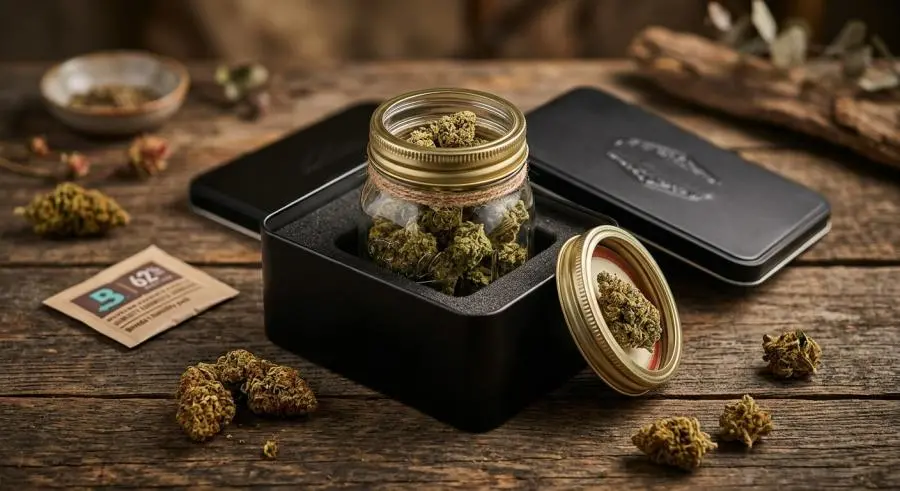
Cost impact: Adds ~$0.15–0.25 per unit versus tin-only. Brands using this strategy — especially in craft and premium segments — command a 20–30% price premium at retail, making the added cost highly profitable.
Several Tier-1 California and Oregon brands have adopted jar-in-tin for flagship flower SKUs, positioning it as the connoisseur-grade standard.
When to use it:- Premium/ultra-premium lines ($50+/eighth retail) - Gifting and seasonal SKUs - Brand launches and limited-edition collaborations - DTC subscription boxes where unboxing video potential matters
VII. Conclusion
Humidity control directly impacts product quality, customer satisfaction, label claim accuracy (THC potency depends on proper storage), and brand reputation.
The data:
Glass jars are the performance champion — best humidity retention, best terpene preservation, best humidity pack compatibility. The right choice for long-term storage, wholesale, and any scenario where product quality is priority one.
Tin boxes win on marketing and logistics — lighter, cheaper to ship, zero breakage, stronger shelf appeal. The right choice for fast-moving retail SKUs, e-commerce, and brands where packaging design is a differentiator.
The jar-in-tin hybrid combines the best of both — glass performance with tin marketing power — and is becoming the premium standard.
Final recommendation: Match the container to the product lifecycle. A brand using one container for every SKU leaves either quality or margin on the table. Test both formats with your strains, humidity packs, and target shelf life. The right answer depends on your customer, your turnover speed, and where you compete.
References
BudTrainer. "How to Cure Cannabis: The 62% RH Jar Curing Guide." 2026. https://www.budtrainer.com/blogs/learn/curing-cannabis
Green Rush Packaging. "The Role of Humidity Packs in Cannabis Storage." 2026. https://greenrushpackaging.com/cannabis-blog/what-is-a-humidity-pack-and-how-will-it-help-me-store-weed/
Electric City Cannabis Co. "How to Store Cannabis Flower Properly." 2026. https://electriccitycannabisco.com/how-to-store-cannabis-flower-properly/
Woody Nelson. "How to Store Cannabis." 2026. https://www.woodynelson.ca/blog/how-to-store-cannabis
IMARC Group. "cannabis packaging Market Report 2026." https://www.marketresearch.com/IMARC-v3797/Cannabis-Packaging-43916488/
Pixels & Packs. "Sustainable Cannabis Packaging: Trends and Innovations." 2026. https://www.pixelsandpacks.co.uk/2026/02/02/sustainable-cannabis-packaging-trends-and-innovations/
Cannabis Promotions. "2026 Cannabis Packaging Trends Brands Can't Ignore." 2026. https://cannabispromotions.com/2026/01/30/cannabis-packaging-trends/