1. Introduction
When a cannabis brand picks packaging, the first fork is rigid or flexible. Boxes and jars feel premium. But pouches are winning — stand-up pouches especially.
A stand-up pouch weighs 40-60% less than a rigid box or jar of comparable capacity. It ships flat, stores flat, takes less warehouse space. On the shelf, the gusseted bottom creates a self-standing display that competes with any rigid package. And for cannabis brands, child-resistant zippers and tamper-evident seals make it a fully compliant solution.
In 2026, pouches are the fastest-growing segment in cannabis packaging. The reason is not just cost. It is the convergence of three trends: mono-material recyclability mandates, demand for lighter shipping to reduce carbon footprint, and consumer preference for resealable formats.
This guide covers everything a cannabis brand needs to know about stand-up pouches — the types, sizing, material science, and compliance.
2. The Five Types of Stand-Up Pouches
2.1 Doypack (Standard Stand-Up Pouch)
The Doypack is the most common format. Gusseted bottom unfolds to create a flat base, letting the pouch stand upright on the shelf. Features a resealable zipper (standard or child-resistant), tear notch, and optional hang hole for peg displays.
- Best for: Flower (3.5g to 28g), pre-roll multi-packs, edibles.
- Market share: Roughly 70% of cannabis pouch orders are Doypacks.
Best balance of shelf presence, production cost, and customization flexibility.
2.2 Flat Sachet / 3-Side Seal Pouch
No gusset. A pillow-format pouch that lies flat. The most cost-effective option.
- Best for: Vape cartridges, disposable pens, sample sizes, single-serving edibles.
- Trade-off: Saves cost, lacks shelf impact. Best for secondary packaging or low-margin SKUs.
2.3 Quad Seal Pouch
Four vertical seals — one at each corner — create a rectangular block when filled. The most rigid pouch format.
- Best for: Premium flower (bulk ounces), concentrates, wholesale, long-shelf-life products.
- Advantage: Rectangular shape prints cleanly, giving a box-like shelf appearance.
More expensive per unit than Doypacks, but a legitimate rigid-box alternative for high-end flower.
2.4 Spouted Pouch
Integrates a hard plastic spout and cap into the flexible body. A niche format essential for specific categories.
- Best for: Cannabis oils, tinctures, infused beverages, vape liquids.
- Key advantage: Shatterproof, lightweight, minimal empty storage — critical for DTC shipping.
2.5 Shaped / Custom Die-Cut Pouch
Die-cut into custom outlines — leaf, hexagon, rounded square.
- Best for: Limited edition drops, premium craft brands, gift sets.
- Cost: $500-$2,000 tooling per shape. Not for high-volume core SKUs.
A marketing tool first. Instant shelf recognition and social media appeal.
3. Sizing Guide — Standard Dimensions and Cannabis-Specific Measurements
3.1 The XS to XXL Size Spectrum
Three critical dimensions: Width (W) × Height (H) × Gusset (G — bottom fold depth).
| Size | Dimensions (W×H×G) | Typical Capacity | Best For |
|---|---|---|---|
| XS | 3.54" × 3.94" × 2.36" | ~48g | Single pre-roll, vape cart |
| S | 3.54" × 6.30" × 2.36" | ~96g | Eighth (3.5g) flower, gummies |
| M-Short | 5.12" × 6.30" × 2.76" | ~192g | Quarter (7g) flower |
| M | 5.12" × 7.87" × 2.76" | ~240g | Half-ounce (14g) flower |
| L | 6.30" × 8.86" × 3.15" | ~480g | Ounce (28g) flower |
| XL | 7.09" × 11.42" × 3.54" | ~960g | Bulk flower, wholesale |
| XXL | 10.24" × 11.81" × 4.33" | ~1.44kg | Bulk shake/trim |
3.2 The Eighth (3.5g) Bag — Most Common Cannabis Format
Two formats dominate the 3.5g SKU:
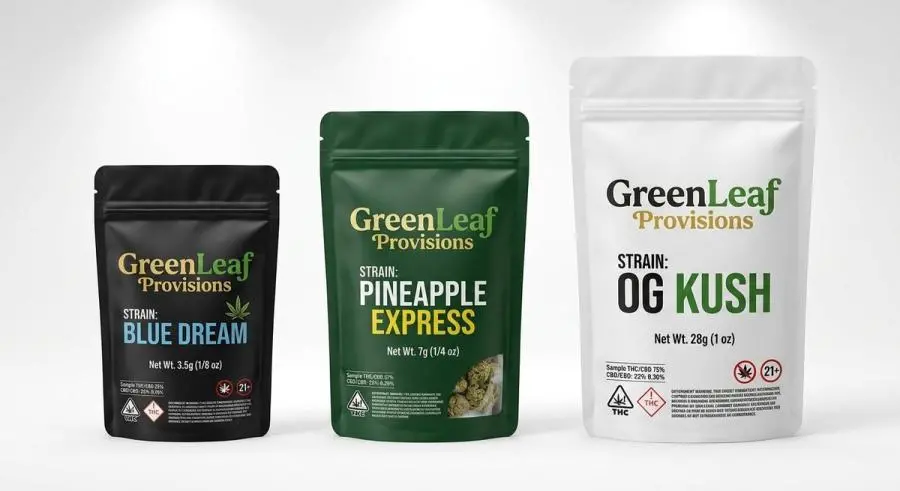
- Flat lay: 2.5" × 4" to 3" × 5". Lower cost, lower shelf impact. Common for value-tier and pre-ground.
- Stand-up Doypack: 3.5" × 5" to 4" × 6", 1.5-2" gusset. Premium look, self-standing. Standard for mid-tier and premium flower.
Cost difference: approximately $0.03-0.08 per unit at volume. Easy for the stand-up format to justify through shelf presence.
3.3 Measuring Fill Volume vs Pouch Size
Three factors first-time buyers miss:
- Zipper headspace: The zipper sits 0.5-1" below the top seal, reducing usable volume by 10-20%.
- Gusset expansion: Under-filled pouches look wrinkled and unstable. The gusset needs enough product to unfold fully.
- Product density: 3.5g of dense flower occupies less volume than 3.5g of fluffy flower. Always test-fill with your actual product.
Rule of thumb: filled product should reach 70-80% of the visible pouch height (below the zipper) for a full, premium appearance.
4. Material Science — Barrier, Sustainability, and Compliance
4.1 Traditional Multi-Layer Laminates
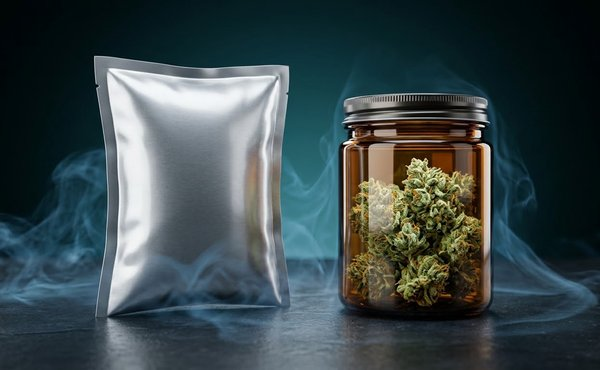
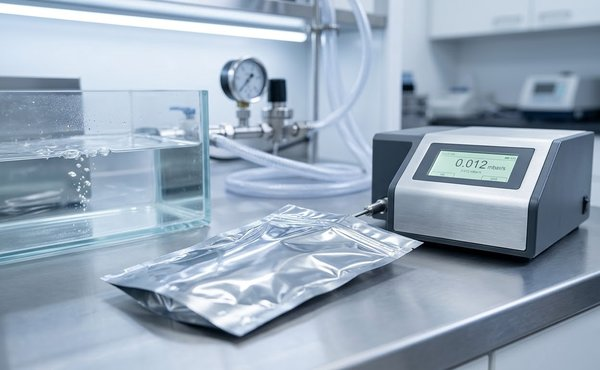
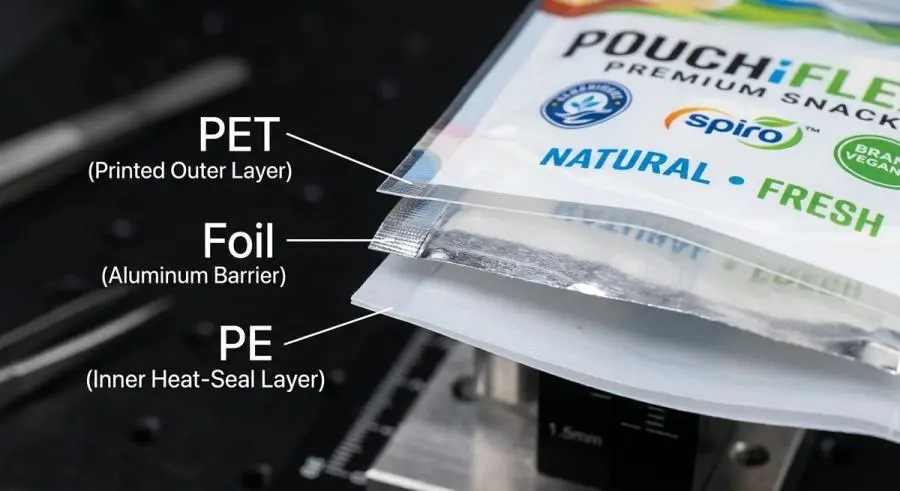
The standard has been PET / aluminum foil / PE: three layers delivering near-perfect barrier.
- OTR: < 0.1 cc/m²/day (virtually impermeable)
- WVTR: < 0.1 g/m²/day
- UV protection: Complete opacity
Excellent for preserving flower and preventing terpene loss. The catch: the aluminum layer makes the pouch non-recyclable.
4.2 The Mono-Material Revolution
Regulatory pressure is pushing toward 100% PE or PP structures that can be recycled in existing film streams. Advanced coatings (SiOx, AlOx) replace the foil layer.
- OTR of mono-material barriers: 0.5-5 cc/m²/day
- Certifications: Interzero "Made for Recycling", SPC guidelines
- Trade-off: 5-10x higher OTR than foil. Adequate for 3-6 month turnover, not for 12+ month shelf life.
4.3 PCR and Compostable Options
Post-Consumer Recycled (PCR) content: - CR PCR stand-up pouches available with CPSC validation. - Typical: 25-50% PCR in the PE layer. - Premium: 10-20% above virgin material cost.
Compostable films: - PLA and kraft paper laminates. - Home-compostable in 90-180 days. - Significant barrier limitation: OTR 50-200 cc/m²/day. - Best for short-shelf-life products or brands prioritizing compostability above all.
4.4 Barrier Properties for Terpene Preservation
| Material | OTR (cc/m²/day) | Terpene Retention (6mo) | Recyclable |
|---|---|---|---|
| PET/foil/PE | < 0.1 | 90-95% | No |
| Mono PE (SiOx) | 0.5-5 | 75-85% | Yes |
| Kraft/PLA compostable | 50-200 | 40-60% | Compostable |
| PCR PE (50%) | 1-10 | 70-80% | Yes |
Premium flower needing terpene preservation beyond 6 months: foil laminate or high-barrier mono-material. Value-tier or fast-turnaround products: mono-material or PCR is sufficient.
5. Child-Resistant Features and Compliance
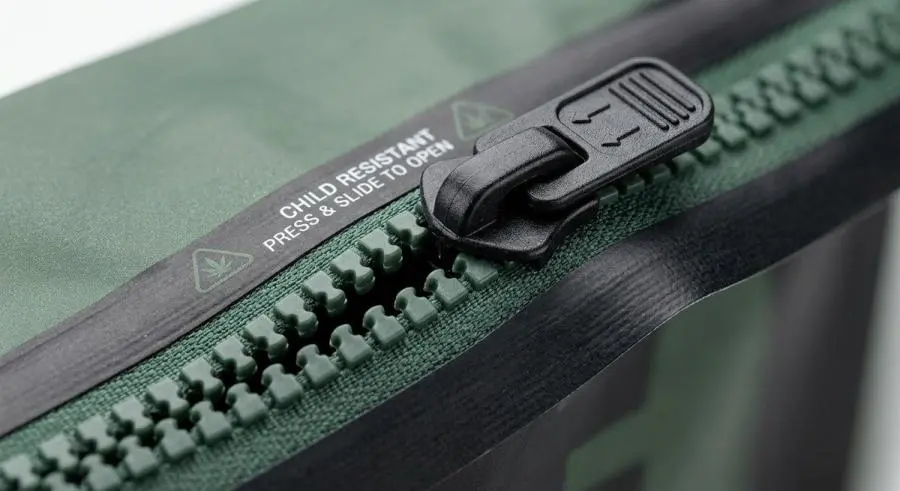
5.1 CR Zipper Technology
Two CR zipper designs dominate stand-up pouches:
- Press-and-slide: Press a tab while sliding open. Two coordinated motions. Most common, lowest cost.
- Pinch-and-pull: Pinch two sides of the zipper track while pulling. Higher force, better test results.
Both must pass ASTM D3475 / 16 CFR 1700.20: children 42-51 months must fail to open (≥80% failure rate), adults 50-70 must succeed.
5.2 Tamper-Evident Features
- Tear notch (indicates previous opening)
- Heat seal above zipper (must be cut for first access)
- Optional shrink band for premium lines
5.3 Label Real Estate and Warning Placement
Stand-up pouches have limited flat surface. Key requirements across states:
- Warning text at minimum font size, high contrast
- Universal cannabis symbol on front panel
- THC/CBD content on back or side
- California Prop 65 adds additional warnings
Front panel usable area is typically 3.5-6" wide × 4-8" tall after accounting for zipper and seals. Provide a compliance checklist to your converter at the design stage.
6. Cost Analysis and Supplier Selection
6.1 Pricing by Type and Volume
| Pouch Type | MOQ | Cost/unit (10k) | Cost/unit (100k) |
|---|---|---|---|
| Flat sachet | 5,000 | $0.08-0.15 | $0.05-0.10 |
| Doypack (standard) | 10,000 | $0.15-0.30 | $0.10-0.20 |
| Doypack (CR zipper) | 10,000 | $0.25-0.45 | $0.18-0.30 |
| Quad seal | 15,000 | $0.30-0.50 | $0.22-0.35 |
| Spouted pouch | 20,000 | $0.40-0.70 | $0.30-0.50 |
| Custom die-cut | 25,000 | $0.35-0.60 + tooling | $0.25-0.40 |
6.2 Customization and Lead Times
- Printing: Gravure (high quality, $500-$1,500 cylinder cost) vs flexo (lower quality, $100-$300 plate cost)
- Finishing: Matte lamination, gloss, spot UV — each adds $0.01-0.03/unit
- Lead time: 3-5 weeks standard. Mono-material and PCR add 1-2 weeks
- Samples: Always request pre-production samples for fill testing and CR documentation
7. Conclusion
Stand-up pouches combine shelf presence with cost efficiency and sustainability. The decision framework:
- Identify your product — flower, pre-roll, edible, oil. Each has a natural pouch type.
- Choose the structure — Doypack for most flower, quad seal for premium, sachet for vapes, spouted for liquids.
- Match the size — Use the XS-to-XXL system. Test-fill with your product.
- Select the material — Mono-material or PCR for sustainability. Foil laminate for premium flower with 12-month shelf life.
- Confirm compliance — CR zipper, tamper-evident, label space for state-specific warnings.
Brands that understand pouch specifications get better pricing and fewer compliance surprises. Brands that treat pouches as a commodity — ordering by price alone — pay for it in returned product and repackaging.
References
- Mylarmen. "An Overview of the Different Types of Pouches for Packaging." 2026. https://mylarmen.com/pouch-packaging-types-to-showcase-your-cannabis-products/
- Era Fame. "Custom Stand Up Pouches: The Versatile Packaging Solution for Modern Brands." 2026. https://erafame.com/custom-stand-up-pouches-the-versatile-packaging-solution-for-modern-brands/
- Pouches.com. "Custom-printed cannabis and CBD pouches." https://pouches.com/pages/tobacco-cbd-packaging
- Marijuana Packaging Solution. "8th Weed Bags - Which Style to Choose: Stand-Up Pouches vs. Flat Lay." https://marijuanapackagingsolution.com/8th-weed-bags/
- Cannabis Business Insights APAC. "A Comprehensive Guide to Customizable Packaging in the Cannabis Industry." 2026. https://www.cannabisbusinessinsightsapac.com/news/-a-comprehensive-guide-to-customizable-packaging-in-the-cannabis-industry-nwid-706.html