Most cannabis brands spend 20% to 40% more than they need to on printed packaging. The culprit is rarely the supplier. It's the print method. Walk into any dispensary and you'll see the evidence: vibrant mylar bags with razor-sharp strain art, crisp compliance text on a pre-roll tube, gold foil accents that catch the light on a concentrate box. Every one of those prints was made on either a rotogravure press or a flexographic press — and the choice between them is the single largest cost driver that most brand owners never think about.
Here is how the two technologies work, where their cost curves cross, and how to decide based on the numbers that matter: run length, design complexity, and budget.
How Rotogravure Printing Works — Precision at Scale
Rotogravure owns the long-run game. If you have ever held a mylar bag with a deep, ink-rich black background or unusually smooth gradients, you were probably holding gravure.
The Technology
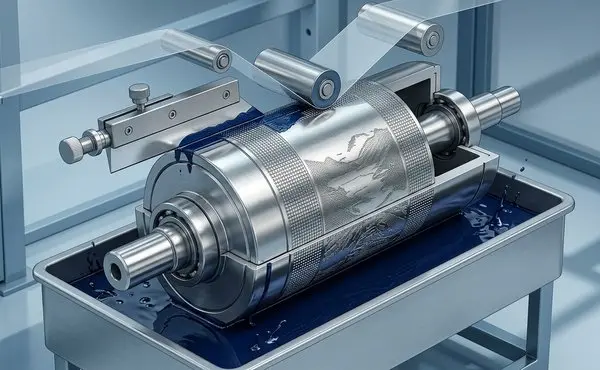
At the heart of gravure lies a set of chrome-plated steel cylinders — one per color in your design. Each cylinder is laser-engraved with millions of microscopic cells that act as tiny ink reservoirs. During printing, the cylinder rotates through an ink bath, a doctor blade scrapes excess ink off the surface so only the cells retain pigment, and the cylinder presses directly against the substrate — mylar film, paper, or board — transferring the ink in a single, precise kiss.
A single cylinder costs $500 to $1,200 per color, meaning a four-color-plus-white setup runs $3,000 to $8,000. These cylinders are built to last: properly maintained, a chrome cylinder can deliver 500,000 to 1 million impressions before showing measurable wear. Gravure presses run at 150 to 400 meters per minute, making them the fastest option for high-volume production.
Why Gravure Excels for Cannabis Packaging
Gravure's deep ink cells deposit more pigment per square inch than any other printing method. On the high-gloss white mylar that dominates cannabis flower packaging, the result is opacity that holds up — a solid block of brand color that looks rich and uniform, not patchy or washed out.
Fine detail reproduction is where gravure truly separates itself. Operating at 200 to 300 lines per inch versus flexo's typical 150 to 200, gravure renders intricate cannabis leaf illustrations, botanical mandalas, and delicate serif typography with near-photographic sharpness. Sub-8pt legal text — the kind you find in CR warning panels and California's required THC symbol specifications — stays legible run after run.
The economics flip dramatically with scale. At 100,000 units, the $6,000 cylinder investment breaks down to $0.06 per unit. At 500,000 units, it's barely over a penny. This is why multinational consumer brands run gravure: the deeper you go, the cheaper each impression becomes.
The Trade-offs
Cylinder fabrication takes two to four weeks before the first test print. If your product launch date moves, your cylinders don't care — they'll be ready when they're ready. More critically, every design revision means re-engraving a cylinder. If a regulator changes the required warning text three weeks before launch, you're looking at an unexpected $500 to $1,200 line item per affected color. For brands that iterate frequently or launch seasonal drops with entirely distinct artwork, gravure's setup cost can feel like a tax on creativity.
How Flexographic Printing Works — Flexibility First
If gravure is a precision rifle, flexo is a Swiss Army knife. It is the default choice for the vast majority of small-to-mid cannabis brands, and for good reason.
The Technology
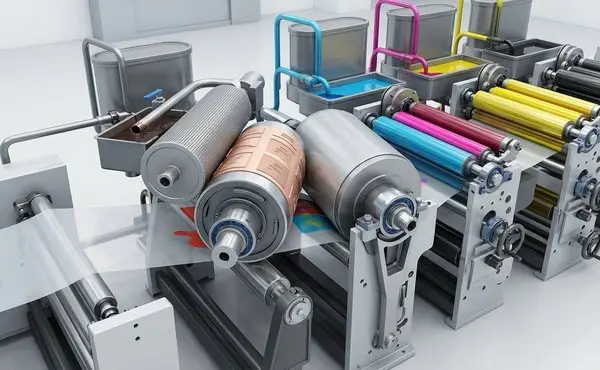
Flexographic printing uses photopolymer plates — think of them as rubber stamps, but with sub-millimeter precision — wrapped around rotating cylinders. Ink is metered by an anilox roll, a laser-engraved ceramic or chrome sleeve covered in uniform microscopic cells that transfer a precisely controlled ink film to the plate. The plate then kisses the substrate, transferring the image.
A full plate set for a four-color design costs $300 to $900 — roughly one-tenth of gravure's cylinder investment. Plates are made in one to three days using digital photopolymer processing or direct laser engraving. Typical press speeds range from 100 to 300 meters per minute, and modern flexo presses handle everything from 30-gauge film to 24-point board without retooling.
Why Flexo Wins for Small-to-Mid Cannabis Brands
A startup ordering 1,000 custom-printed mylar bags faces a clear decision: $6,000 for gravure cylinders and a month of waiting, or $600 for flexo plates and printing next week. On pre-revenue capital, the $5,400 difference covers a trade show booth, a second SKU, or professional product photography.
Flexo also enables marketing agility. A brand running monthly strain drops, holiday limited editions, or compliance-specific regional variants can swap plate designs for a few hundred dollars per iteration. Try that on gravure and the cost will show up in the next P&L review.
Substrate versatility is another underrated advantage. A single flexo press can print on kraft paper boxes in the morning, mylar film pouches in the afternoon, and corrugated shippers by evening — with plate changes measured in minutes, not days.
The Trade-offs
Flexo's resolution ceiling is real. At 150 to 200 LPI, extremely fine detail — the kind you'd see in a photorealistic trichome close-up on a concentrate box — will appear softer than the gravure equivalent. Dot gain, the tendency for ink to spread slightly at the edges of each printed dot, is inherently higher in flexo due to the compressible nature of photopolymer plates. This means solid-color backgrounds may look slightly less saturated, and fine lines (such as serifs on small text) may thicken marginally.
Color consistency across long runs also requires more active process control. Photopolymer plates begin to show measurable wear after 50,000 to 100,000 impressions, leading to subtle shifts in ink transfer and color density. For brands printing 200,000 units of a single SKU, this means either replacing plates mid-run or accepting a slight drift.
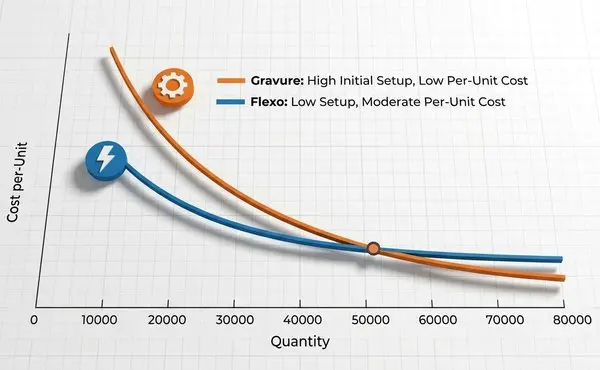
The Cost Crossroads — Run-Length Analysis
Cost Component Breakdown
| Cost Component | Gravure | Flexo |
|---|---|---|
| Plate/Cylinder Fabrication (4-color) | $3,000–$8,000 per set | $300–$900 per set |
| Ink & Material per Unit | $0.03–$0.08 | $0.05–$0.12 |
| Setup Waste (first 200 impressions) | Higher (cylinder registration) | Lower (faster make-ready) |
| Design Change Cost | Full cylinder re-engraving: $500–$1,200/color | Plate replacement: $75–$225/color |
| Lead Time (from approved art) | 2–4 weeks | 1–3 days |
| Plate/Cylinder Life | 500K–1M impressions | 50K–100K impressions |
Three Scenarios, One Spreadsheet
Scenario A: Startup Brand — 1,000 Units
You are launching your first strain. You need 1,000 mylar bags with your logo, strain name, and compliance text. Four colors.
Gravure: $6,000 (cylinders) + $80 (ink/material) = $6,080 total → $6.08 per bag.
Flexo: $600 (plates) + $100 (ink/material) = $700 total → $0.70 per bag.
At this volume, gravure costs 8.7 times more. No debate. Flexo is the only rational choice. The $5,400 saved pays for the product inside the bags.
Scenario B: Mid-Tier Brand — 25,000 Units
You've been in the market for 18 months. Your flagship strain moves 25,000 units per year across three states. You value print quality but watch margins carefully.
Gravure: $6,000 (cylinders) + $1,500 (ink/material) = $7,500 total → $0.30 per bag.
Flexo: $600 (plates) + $2,500 (ink/material) = $3,100 total → $0.12 per bag.
Flexo still wins on pure cost — $0.18 less per unit, or $4,500 saved across the year. But the gap is closing. At this volume, some brands begin to justify gravure on quality grounds: the premium print improves shelf appeal, and if it converts even 3% more browsing customers into buyers at a $40 average purchase, that $4,500 pays for itself in a few weeks.
Scenario C: Multi-State Powerhouse — 150,000 Units
You are running 150,000 units of your hero SKU across six states. Brand consistency is non-negotiable. The per-unit cost is everything.
Gravure: $6,000 (cylinders) + $7,500 (ink/material) = $13,500 total → $0.09 per bag.
Flexo: $600 (plates) + $15,000 (ink/material) = $15,600 total → $0.10 per bag.
Gravure pulls ahead. One penny per unit doesn't sound dramatic, but across 150,000 units it's $1,500 saved — and that's before accounting for the plate replacements flexo would need for a run this size (at least two plate sets at $600 each, adding another $1,200). The real crossover lands somewhere between 30,000 and 50,000 units for most cannabis packaging applications.
The 30,000–50,000 Unit Tipping Zone
Most brands never get a clean spreadsheet answer because they fall into this gray zone. Here is how to break the tie:
Design reuse across SKUs: If three strains share the same brand template and only the strain name changes, those gravure cylinders can be shared — slashing the per-SKU cylinder cost to $2,000 or less. This tilts the zone heavily toward gravure.
Frequency of redesign: Brands that refresh artwork twice a year will never amortize gravure cylinders before the next redesign. Stay on flexo.
Premium positioning: If your brand sells $60 eighths versus $25 eighths, the $0.06–$0.18 per-unit print premium of gravure is noise. Invest in the quality.
Quality Showdown — What the Customer Sees
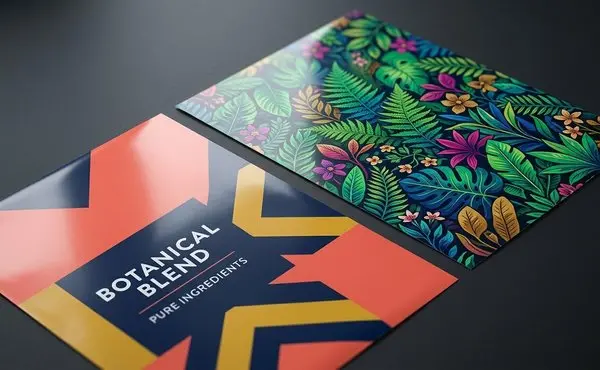
Cost gets you to the table. Quality gets you picked up off the shelf. Here is how the two methods compare on the three dimensions that matter for cannabis packaging.
Color Gamut and Opacity
Gravure deposits a heavier ink film — typically 1.5 to 2.5 times the ink volume of flexo. On high-gloss white mylar, the most common substrate in cannabis flower packaging, this difference translates to visibly richer solid backgrounds. A deep forest green or midnight purple looks like paint on gravure; on flexo, the same color may show subtle substrate texture or unevenness.
Opacity matters most for reverse-printed film, where the ink sits on the inside of the mylar and is viewed through the film itself. Gravure's thick ink layer blocks light transmission more effectively, which is why premium brands gravitate toward it. Flexo can achieve comparable opacity with a double-hit of white ink as a backing layer, but that adds a plate station, cost, and complexity.
Fine Detail and Typography
Every cannabis package carries mandatory compliance text. In most states, that means a warning statement, a universal THC symbol, and ingredient or cannabinoid content declarations — often in 6pt to 8pt type. Gravure's ±0.1 mm registration accuracy keeps these elements sharp. Flexo handles 8pt and above reliably but can introduce slight edge roughness below that threshold, especially on film substrates where dot gain is most pronounced.
For decorative elements — strain illustrations, brand logos with intricate lines, photorealistic flower photography reproduced as halftone — gravure's 200–300 LPI resolution is the gold standard. Flexo at 150–200 LPI is perfectly adequate for bold, graphic-driven designs, the kind that dominate modern cannabis branding. Unless your packaging relies on photographic realism, flexo's quality ceiling will not hold you back.
Batch-to-Batch Consistency
If you have ever unboxed a shipment and noticed that the latest batch of bags is slightly "warmer" or "cooler" than the last, you experienced color drift. Gravure's chrome cylinders are essentially immutable — they produce identical ink transfer volumes from impression 1 through impression 500,000. Flexo plates, being polymer, begin to deform microscopically after 50,000 to 100,000 impressions. The change is gradual, easy to miss, and cumulative. For brands ordering quarterly reprints of the same SKU, each batch starts fresh with new plates and should match. The risk is within a single large run: if a flexo job hits 120,000 impressions, the later pouches may look slightly different from the earlier ones.
Decision Framework — Which Print Method for Your Brand?
Go Flexo If
Your annual volume per SKU is under 30,000 units.
You launch seasonal drops, limited editions, or test-market variants at least twice a year.
Speed to market matters — you need bags in hand within three weeks of approving artwork.
Your designs lean toward bold graphics, heavy solids, and clean typography rather than photographic reproduction.
You are printing on kraft paper, uncoated stocks, or matte films where the substrate naturally masks minor ink film differences.
Go Gravure If
Your annual volume per SKU exceeds 100,000 units.
Your brand identity depends on photorealistic imagery, fine line work, or large areas of solid dark color on glossy film.
Color consistency across 12-plus months of production is a non-negotiable brand standard.
You have the lead time — at least four weeks from art approval — and relatively stable designs.
Compliance elements (warning text, THC symbols) appear at sizes below 7pt and must remain legible.
The Hybrid Strategy
Large multi-state brands can use both. Run gravure for the three to five hero SKUs that move 200,000-plus units per year — where the per-unit cost advantage is real and the quality floor must hold. Run flexo for everything else: seasonal releases, new strain trials, sample kits, event packaging. Gravure captures scale economics where volume exists; flexo preserves agility for the innovation pipeline.
When a flexo-launched strain proves itself and earns a permanent slot, its artwork migrates to gravure for the next production cycle. You invest in cylinders only for proven winners. One multi-state operator runs this model: three flagship strains on gravure at roughly $18,000 total cylinder investment, all new product launches on flexo at $600 per design, with a quarterly review to decide which flexo designs graduate to gravure. Their print spend per unit dropped 22% in year one.
Conclusion
The choice between gravure and flexo is not about which technology is better. It is about which technology fits your volume, your design language, and your growth trajectory.
Pull up your 2026 projections. Look at your per-SKU run lengths. If the number is under 40,000 units, flexo is almost certainly the correct call — the setup cost gap is simply too large to justify anything else. If the number is over 80,000 units, get a gravure quote and compare it to your current flexo spend. If you are in between, run the quality variables: how important is photographic detail, how stable are your designs, and what does your per-unit margin look like after the print cost?
The most expensive mistake is not choosing one or the other. It is choosing without running the numbers at all.