Introduction
"Sustainable packaging" is the most common claim on cannabis packaging in 2026. Most brands cannot explain what their eco-label actually means.
The gap between claiming and certifying is where legal risk lives. The FTC Green Guides have already targeted misleading "biodegradable" and "eco-friendly" claims across consumer goods. Cannabis is not exempt. The EU Packaging and Packaging Waste Regulation (PPWR) takes effect in August 2026, creating ripple effects that reach North American cannabis brands importing materials or exporting products.
The problem is not a lack of certification options. It is that FSC, How2Recycle, and BPI/TÜV serve entirely different purposes — and confusing them wastes money, creates false claims, or both.
FSC certifies fiber sourcing — where the paper came from. How2Recycle grades recyclability — whether your local MRF can handle it. BPI and TÜV certify compostability — whether it breaks down and under what conditions. These are not interchangeable.
FSC Certification — Tracing the Fiber from Forest to Package
What FSC Actually Certifies
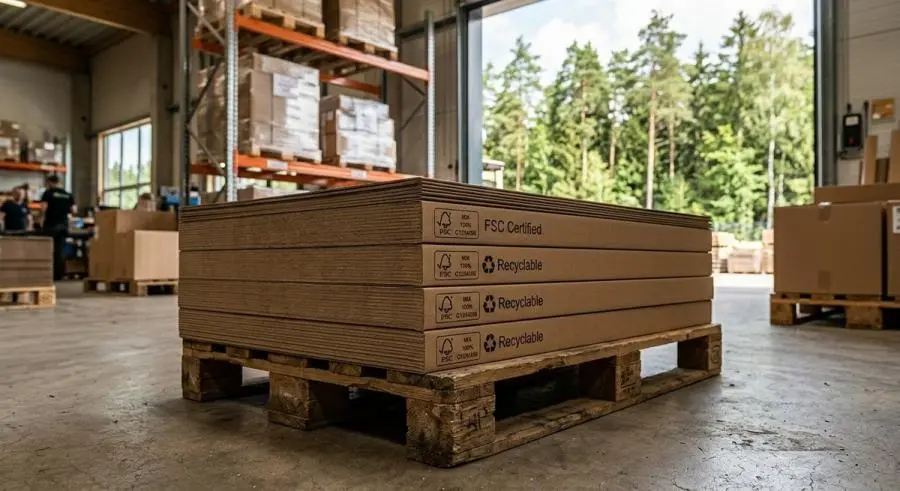
The Forest Stewardship Council certifies chain of custody for paper and paperboard fiber. Three label tiers:
FSC 100%: All fiber from FSC-certified well-managed forests
FSC Mix: At least 70% from certified or recycled sources, balance from controlled sources
FSC Recycled: 100% post-consumer or post-industrial recycled fiber
FSC does not certify recyclability, compostability, or carbon footprint. It only addresses sourcing.
Why Cannabis Brands Need It
FSC is not a legal requirement for US cannabis packaging, but market pressure is making it a de facto baseline:
California Prop 65: The regulatory push toward chemical disclosure is driving brands toward verified supply chains
EU market access: Selling into Europe means FSC as part of corporate sustainability due diligence
Retailer mandates: Whole Foods and Walmart increasingly specify FSC-certified paperboard
The cost: FSC-certified paperboard adds 8–15% versus non-certified equivalents. The premium has shrunk from 20-25% in 2020.
Common Misunderstanding
FSC is frequently confused with end-of-life claims. An FSC-certified box is not automatically recyclable or compostable. It addresses fiber source, not disposal outcome. A cannabis brand could have FSC-certified paperboard laminated with non-recyclable materials — certified sourcing, non-recyclable package.
How2Recycle — The Most Misunderstood Label in Cannabis Packaging
The Grading System
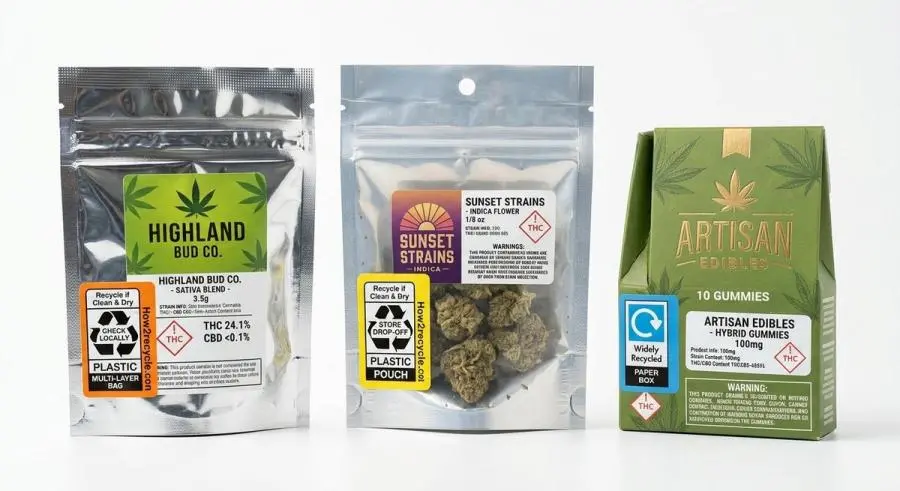
How2Recycle, operated by the Sustainable Packaging Coalition, uses four tiers:
| Label | Meaning | Consumer Action |
|---|---|---|
| Widely Recyclable | Accepted by 60%+ of US MRFs | Curbside bin |
| Check Locally | Accepted by 20-60% of MRFs | Verify with local facility |
| Not Yet Recyclable | Accepted by <20% of MRFs | Do not recycle |
| Store Drop-Off | Flexible film at retail | Return to participating store |
The 60% threshold is critical. Many packaging formats that feel recyclable fall below it because regional recycling infrastructure varies dramatically.
The Cannabis Packaging Dilemma
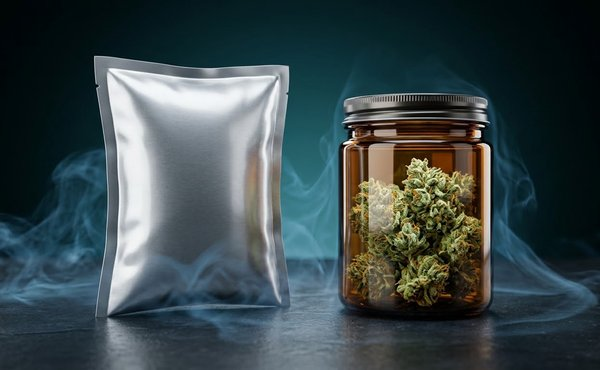
Multi-layer barrier films dominate cannabis packaging — they protect freshness, contain odor, and provide child resistance. They also nearly always rate "Not Yet Recyclable."
| Common Structure | How2Recycle Rating | Why |
|---|---|---|
| PE/EVOH/PE (EVOH >5%) | Not Yet Recyclable | EVOH contaminates PE stream |
| PET/EVOH/PE barrier pouch | Not Yet Recyclable | Multi-polymer, non-separable |
| Metallized film laminate | Not Yet Recyclable | Metal layer contaminates plastic |
| Aluminum foil laminate | Not Yet Recyclable | Metal-polymer composite |
| Mono-material PE (no barrier) | Check Locally | Some MRFs accept clear PE |
| PE+EVOH (<5%) | Check Locally | Emerging acceptance |
| Paperboard box (unlaminated) | Widely Recyclable | Standard paper stream |
The structures that best preserve cannabis are structurally incompatible with current recycling infrastructure.
The Store Drop-Off Alternative
Flexible plastic films (clean and dry) can be collected through Store Drop-Off at Walmart, Target, and Kroger. The channel accepts polyethylene films including some barrier structures. Consumer participation: 5-10%.
The Mono-Material Shift
The most significant 2026 development: mono-material structures with minimal EVOH content. PE/EVOH/PE where EVOH stays below 5% of total film weight is beginning to qualify for "Check Locally" — a meaningful improvement from "Not Yet Recyclable." Driven by:
Improved EVOH dispersion technology maintaining barrier at lower content
MRF trial programs testing low-EVOH acceptance
Brand pressure from EU PPWR compliance timelines
BPI and TÜV — The Compostability Certification Maze
US vs. EU Standards

"Compostable" means different things depending on who certified it:
| Certification | Standard | Region | Conditions | Timeframe |
|---|---|---|---|---|
| BPI | ASTM D6400/D6868 | US | Industrial | 90-180 days |
| TÜV OK Compost INDUSTRIAL | EN 13432 | EU | Industrial | 90-180 days |
| TÜV OK Compost HOME | EN 13432 + stricter | EU | Home bin | 365 days |
| CMA | Field testing | US | Industrial | Verified in facility |
The Industrial Compost Reality Check
Most industrial composting facilities in the US will not accept cannabis packaging even with BPI certification. Reasons:
Residual plant material and oils can contaminate batches
QA protocols reject packages they cannot visually verify as compostable
Most facilities have not updated acceptance criteria for newer certified materials
BPI certification gives legal cover for a "compostable" claim. It does not guarantee the package will actually be composted.
Home Compostable Certification
TÜV OK Compost HOME is the only certification guaranteeing breakdown in a backyard bin. Test conditions are more demanding: ambient temperatures (20-30°C) versus industrial 50-60°C, 365-day versus 90-180 days. Fewer materials pass. Those that do typically have shorter shelf life and lower moisture barrier.
For cannabis packaging, this creates a fundamental tension: home-compostable materials rarely provide 6-12 month barrier performance, while industrial-compostable materials lack the collection infrastructure to be actually composted.
2026 Regulatory Crosswinds — EU PPWR and FTC Green Guides
EU PPWR — August 2026
Key provisions affecting cannabis packaging imports:
Design for recycling: All packaging on the EU market must meet recyclability criteria by 2030
Recycled content mandates: Minimum post-consumer recycled content in plastic packaging
Compostability restrictions: Only tea bags, coffee pods, and fruit stickers are exempt from recyclability requirements
Direct impact: if you export to Europe or supply brands that do, your multi-layer barrier packaging must demonstrate a path to recyclability. 2026 is the year to start transitioning to mono-material or separable structures.
FTC Green Guides
Recent FTC enforcement:
2024-2026: Multiple actions against "biodegradable" claims for plastics that do not biodegrade in landfill conditions
Recyclability claims: Must demonstrate "broad" MRF access — generally interpreted as 60%+
Compostable claims: Must be substantiated by ASTM/BPI certification and qualified if only industrially compostable
For cannabis brands: claiming "recyclable" on a multi-layer barrier pouch without How2Recycle verification is regulatory exposure. Claiming "compostable" without specifying industrial vs. home conditions is equally risky.
California SB 54
Requires all packaging sold in California to be recyclable or compostable by 2032. Cannabis-specific exemptions may apply, but the law signals direction. Brands selling into California should treat SB 54 as a packaging design constraint.
Practical Certification Strategy for Cannabis Brands
Certification Prioritization by Market
| Target Market | Baseline | Nice-to-Have | Skip Unless Necessary |
|---|---|---|---|
| US domestic (specialty) | How2Recycle | FSC | BPI (low composting access) |
| US domestic (mass retail) | FSC + How2Recycle | Store Drop-Off | Home compostable |
| EU export | FSC + PPWR compliance | Recycled content verification | BPI (PPWR restricts compostables) |
| Canada | How2Recycle | FSC | BPI (limited infrastructure) |
Cost-Benefit Snapshot
For a mid-size brand at 200,000 units/year:
| Certification | Annual Cost | Credibility | Compliance Value |
|---|---|---|---|
| How2Recycle | $5K-10K | High — retailer recognized | High — FTC defense |
| FSC | $3K-8K | Medium — increasingly expected | Medium — retailer req |
| BPI | $2K-5K | Medium — conditional on infra | Low — limited composting |
| TÜV HOME | $8K-15K | High — genuine differentiator | Low — limited material options |
Supplier Verification Checklist
Certification certificates: Current (within 12 months) documents, not marketing claims
Chain of custody scope: FSC Mix vs. 100% vs. Recycled — verify the specific label
How2Recycle registration: Confirm the specific structure is registered, not a similar one
BPI test report: ASTM D6400 pass criteria — request the actual test report
MRF acceptance data: For "Check Locally" claims, ask which MRFs in your target states accept the material
Conclusion
No single certification covers all sustainability dimensions. FSC addresses sourcing. How2Recycle addresses end-of-life sorting. BPI/TÜV address compostability. Three separate problems, three separate solutions.
Smart approach for 2026: How2Recycle as baseline (best for consumer communication and regulatory defense), add FSC for paper-based components, pursue compostability only when material and infrastructure actually align.
PPWR and FTC enforcement point in the same direction: brands that document certification claims now will transition smoothly as requirements tighten in 2027-2030. Those relying on unverified "eco-friendly" claims are accumulating risk.
Bottom line: Audit your packaging claims against the FTC Green Guides. Verify every certification with the issuing body's database — a supplier's marketing claim is not certification. If your package cannot pass How2Recycle "Check Locally" today, start the mono-material transition. The regulatory clock is ticking.