Introduction
You open a jar of premium flower you cured yourself. The nose hits, then fades fast. Six months later, the same batch tastes flat, the high feels thinner, and the lab report shows more CBN and less THC than the COA promised. Most cultivators blame genetics or cure. In most cases, the real culprit is oxygen — and the packaging decision made at harvest.
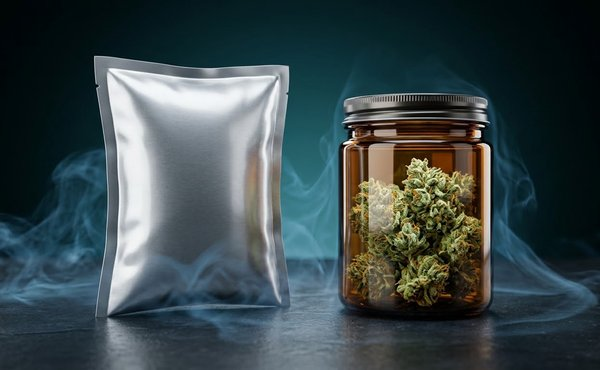
Oxygen is the single biggest chemical threat to dried cannabis. It drives THC oxidation toward CBN, volatilizes terpenes, and creates conditions for microbial growth. The classic response — burping the jar every day — is labor, inconsistency, and lost potency rolled into one ritual. Food and pharmaceutical industries solved this problem decades ago with nitrogen flushing and modified atmosphere packaging (MAP). Now the data is catching up for cannabis: a 2026 peer-reviewed stability study confirms that nitrogen-flushed aluminum laminate bags retain THC and terpene quality significantly better than ambient-sealed jars over nine months of storage.
This guide explains the science, the two practical approaches (nitrogen flush vs. MAP), and the exact questions to ask your packaging supplier. If you sell premium flower, this is the difference between a product that degrades on the shelf and one that still sells its aroma.
1. The Chemistry of Degradation: Why Oxygen Kills Cannabis Quality
1.1 Oxidation Pathways
Dried cannabis flower is a chemically unstable product. The two most valuable compound groups — cannabinoids and terpenes — are both vulnerable to oxidative degradation:
- THC → CBN: Delta-9-THC oxidizes into CBN (cannabinol), which is less psychoactive and produces a sedating effect. The more oxygen exposure, the faster the conversion.
- Terpene volatilization: Terpenes are volatile aromatic hydrocarbons. They evaporate continuously, and oxidation accelerates the loss of the compounds that drive flavor and the entourage effect.
- Microbial risk: Elevated moisture plus oxygen creates conditions for mold and yeast, particularly when humidity drifts above the 58-62% RH sweet spot.
The practical consequence: potency drops, aroma flattens, and the product fails to deliver what the COA promises. In a market where consumers buy on nose and experience, that is lost revenue per gram.
1.2 The 2026 Study: Hard Data on Nitrogen Flushing
A study published in 2026 in KNOWLEDGE International Journal (Vol. 74, Issue 4) put nitrogen flushing to a rigorous test. Researchers compared two commercially relevant packaging systems for dried Cannabis sativa L. flower:
- Multilayer aluminum laminate bags, flushed with nitrogen (modified atmosphere)
- HDPE jars sealed without inert gas (ambient headspace)
Four batches from two commercial strains were stored at 25±2°C and 60±5% RH, then analyzed at predefined time points up to nine months. The results:
- All nitrogen-packaged samples remained within specification throughout the nine-month study.
- One ambient-packaged batch went out-of-specification at month nine — the exact kind of failure that triggers batch holds, returns, and brand damage.
- THC retention was measurably better in the nitrogen-packaged laminate bags, attributed to the combined effect of reduced headspace oxygen and the superior barrier of aluminum laminate.
The takeaway is direct: nitrogen-modified atmosphere packaging is an effective strategy for improving the chemical stability of dried flower without compromising microbiological compliance.
1.3 Headspace Oxygen vs. Barrier: Two Independent Variables
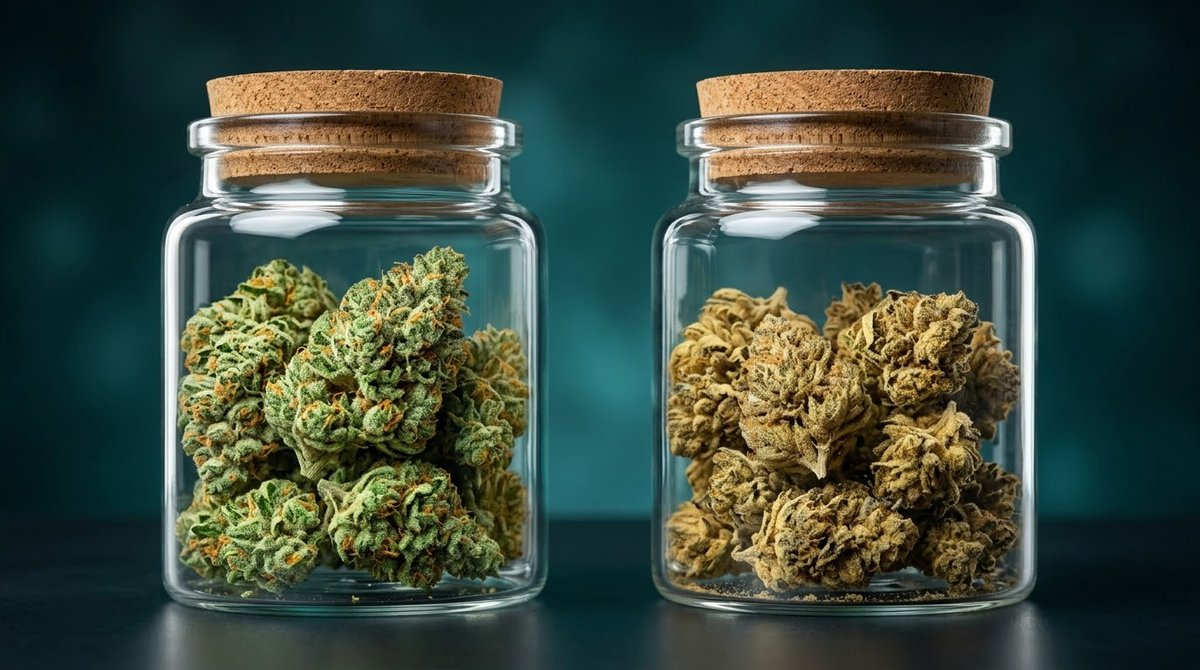
Here is the point most brands miss: the packaging material's barrier (OTR/WVTR) and the atmosphere inside the package are two separate variables. A high-barrier bag sealed with ambient air still contains 20.9% oxygen in the headspace — that oxygen attacks the product from the inside, regardless of how well the film blocks outside oxygen.
Nitrogen flushing removes the internal oxygen. The barrier then keeps new oxygen out. Neither alone is sufficient; together they change the storage equation. This is why the 2026 study's combination — nitrogen flush plus aluminum laminate — outperformed the jar that had a decent closure but ambient air inside.
2. How Nitrogen Flushing Works: Process, Equipment, and Targets
2.1 The Principle: Displacing Oxygen Before Sealing
Nitrogen flushing is simple in concept: replace the oxygen in the package headspace with inert nitrogen before the seal is made. In production, this is typically done one of two ways:
- Gas flushing: A nitrogen stream purges the package interior just before sealing, washing out oxygen.
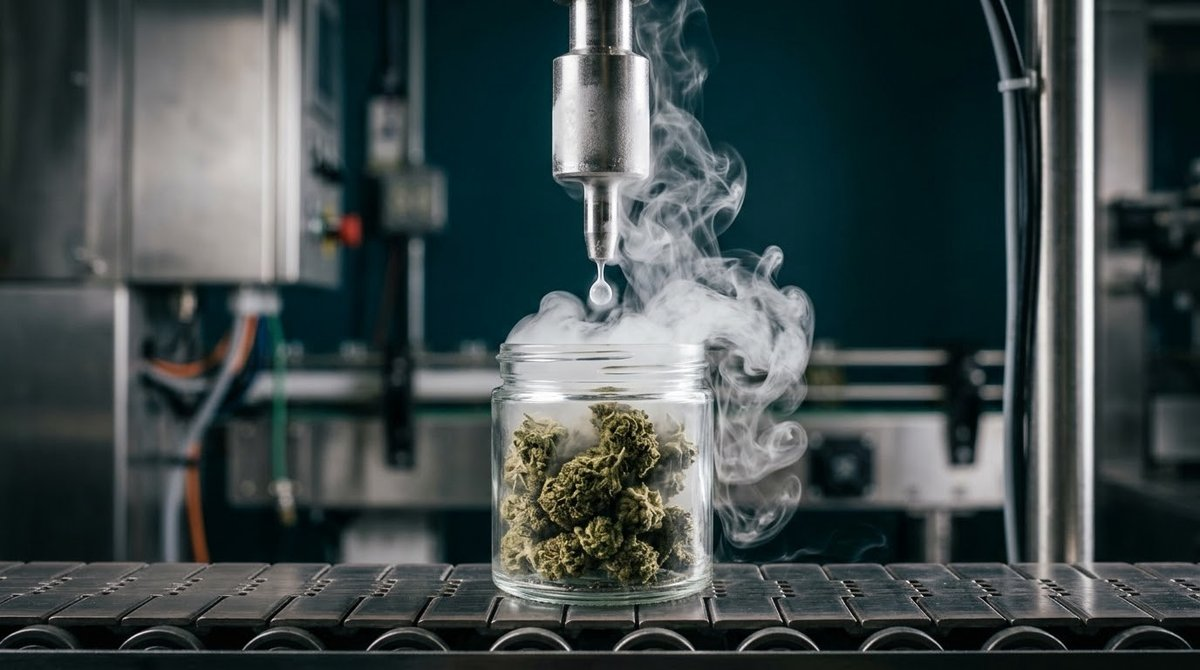
- Liquid nitrogen dosing: A small drop of liquid nitrogen is released into each container just before capping. As it rapidly evaporates and expands, it displaces the oxygen and creates positive pressure inside.
The second approach is what Samuel Morris' PopVac technology brought to cannabis: an automated manufacturing line that nitrogen-flushes jars at fill speed. As Morris puts it, "You have to be very serious about your packaging and seal, because it's everything. Your weed dries, your cannabinoid profile changes, and your buzz changes."
2.2 Residual Oxygen Targets
Food and pharmaceutical MAP practice provides the benchmark. Common targets:
- Standard MAP: 1-3% residual oxygen in the headspace — a large improvement over ambient 20.9%.
- High-barrier / long-shelf-life: <0.5% residual oxygen, achieved with thorough flushing and low-leak seals.
For cannabis flower with 6-12 month target shelf lives, aiming for <2% residual oxygen at seal time is a reasonable, verifiable target. The key word is verifiable: request headspace oxygen measurement data from your line or your co-packer, not just the process description.
2.3 Line Integration and QC
Nitrogen flushing is only as good as the sealing and measurement around it. Practical requirements:
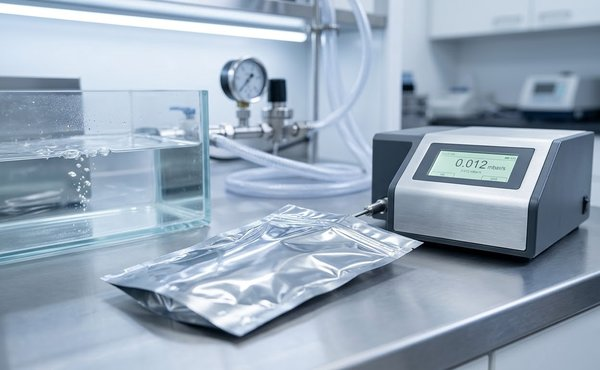
- Sealing integrity first: A flush is wasted if the seal leaks. Leak testing — water bath, pressure decay, or vacuum decay — should be standard before you invest in nitrogen.
- Batch-to-batch consistency: Flush volume, nitrogen purity, and seal dwell time must be controlled and documented.
- In-line verification: Headspace oxygen analyzers on the packaging line give you real-time confirmation that the flush is working.
2.4 Cost Picture
Nitrogen itself is inexpensive — often a fraction of a cent per unit at scale. The real costs are the equipment (nitrogen generator or liquid nitrogen dosing system) and the process validation. For a producer moving meaningful volume, the per-unit cost is small relative to the quality protection gained. We'll return to the ROI math in Section 5.
3. MAP vs. Nitrogen Flush: Two Strategies, One Goal
3.1 What MAP Actually Means
Modified atmosphere packaging (MAP) covers any approach that changes the gas composition inside the package to slow degradation. Nitrogen flushing is one implementation. MAP is the broader category.
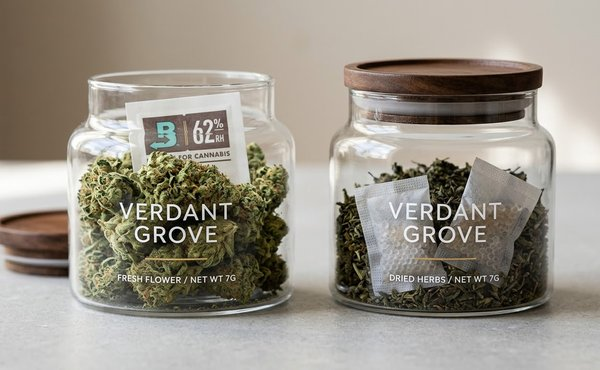
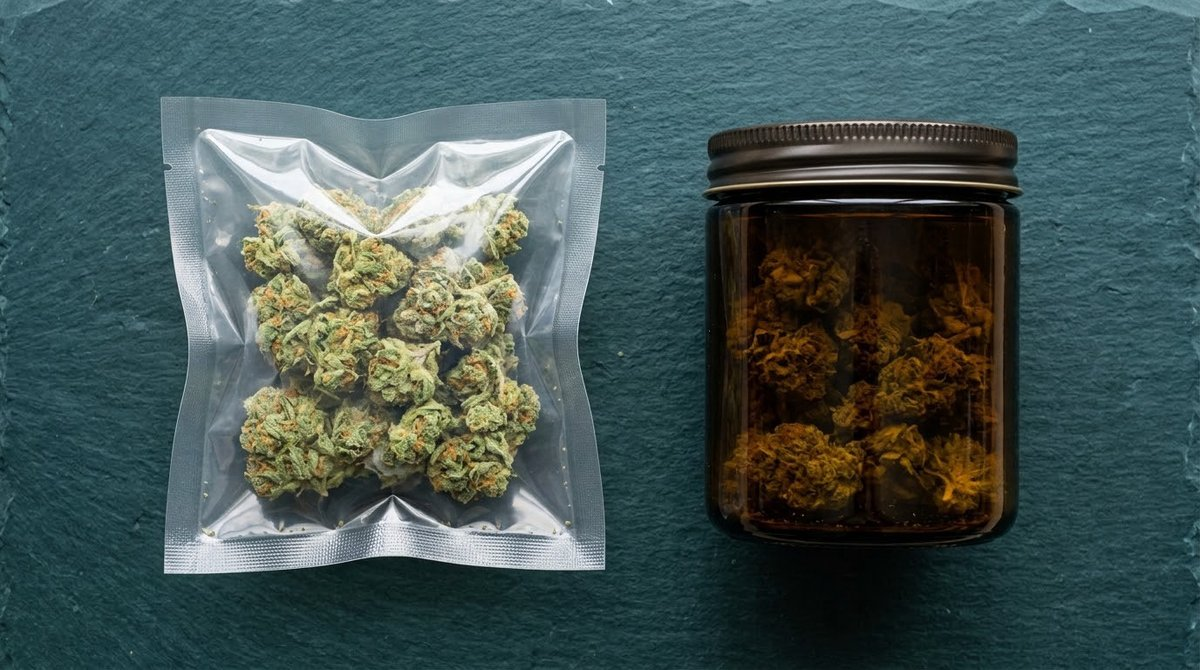
For cannabis, the most interesting MAP implementation comes from Grove Bags. Its multilayer film creates a self-regulating microclimate: when flower is sealed inside, the plant continues to off-gas CO₂. That CO₂ displaces oxygen, producing a non-oxygen-rich environment that slows oxidation — while the film's permeability keeps humidity in the 58-62% RH band. As Grove Bags' Lance Lambert describes it: "It's essentially auto-curing. No more burping jars or babysitting your cure. You just put the flower in the bag and let it do its job."
3.2 When to Choose Which
| Consideration | Nitrogen Flush | MAP Film (e.g., Grove Bags) |
|---|---|---|
| Best format | Jars, rigid containers, pouches on automated lines | Flexible bags, post-harvest to retail |
| Atmosphere control | Active, immediate, measurable | Passive, self-regulating |
| Automation fit | High (liquid N₂ dosing integrates with capping lines) | Low (standard bagging/sealing) |
| Curing in transit | Limited | Yes — "cure in transit" model |
| Verification | Headspace O₂ analyzer | Trust the film's behavior; periodic testing |
The practical rule: if you run an automated fill-and-cap line, nitrogen flush is the natural fit. If you bag flower from harvest through retail and want to simplify handling, a MAP film may deliver most of the benefit with less equipment.
3.3 The 58-62% RH Sweet Spot
Both approaches share a critical goal: holding humidity in the 58-62% RH range. Nitrogen flush preserves the moisture already in the flower by reducing air exchange; MAP films actively balance excess moisture. Either way, humidity stability is what keeps flower from drying out (terpene loss) or getting damp (microbial risk). If your supplier can't explain how the packaging maintains this band, that's a red flag.
4. Real-World Implementation: What to Ask Your Packaging Supplier
4.1 Ask for the Numbers, Not the Adjectives
"High barrier" and "premium" are marketing words. The numbers that matter:
- OTR (oxygen transmission rate): e.g., <5 cc/m²/day for high-barrier films
- WVTR (water vapor transmission rate): e.g., <5 g/m²/day
- Residual headspace oxygen: your target, e.g., <2% at seal
Request these from your supplier with the test methods used. If they can't provide them, find another supplier.
4.2 Sealing Integrity Comes First
Nitrogen flushing assumes a seal that holds. Before investing in flush equipment, verify your current seal quality with leak testing (water bath, pressure decay, or vacuum decay per the standards in our leak-testing guide). A flush-capable line with leaky seals wastes both nitrogen and product.
4.3 Documentation for Compliance and Claims
If you plan to make shelf-life claims, demand:
- Stability study data (like the 2026 KNOWLEDGE study) or your own accelerated stability testing
- Seal integrity and leak test reports per batch
- Material certifications (food-contact compliance, barrier spec sheets)
Under ICH Q1A(R2) stability testing frameworks, packaging is a documented variable — treat it as such.
4.4 Budget the Delta
Nitrogen-flush-ready packaging (flushable closures, validated seals) costs more than standard packaging, but the delta is modest relative to the value protected. Factor in:
- Equipment or co-packing premium
- Nitrogen supply
- QC testing per batch
- ROI timeline: fewer returns, retained premium pricing, extended sellable window
5. The Bottom Line: Does Nitrogen Packaging Pay for Itself?
5.1 Quality Retention = Revenue Retention
The clearest ROI is avoiding degradation losses. A batch that fails spec at month nine — as one ambient-packaged batch did in the 2026 study — means a full batch hold, retesting, discounting, or disposal. Nitrogen flushing shifts that risk to near zero for most flower SKUs. Add the premium-price retention (consumers pay more for flower that still smells and hits like fresh), and the payback is usually measured in months, not years.
5.2 Curing in Transit: The Supply Chain Bonus
MAP films add a second benefit: product continues curing during transit. Grove Bags reports licensed producers in Europe use this to "cure in transit" — reducing the need for weeks of warehouse curing and freeing space and time. For operators shipping to distributors, that's a tangible operational win.
5.3 Right-Sizing: Don't Over-Engineer
Not every SKU needs nitrogen flush. A fast-moving 3.5g package with a 3-month shelf life doesn't need the same spec as a premium 28g jar with a 12-month target. Over-engineering barrier and atmosphere for short-life products adds cost without return. Design to the minimum viable barrier for your product class and shelf-life target — then verify with data.
Conclusion
Oxygen is the silent killer of cannabis quality — it converts THC to CBN, flattens terpenes, and invites microbial problems. The 2026 stability data now confirms what food and pharma have known for decades: removing headspace oxygen with nitrogen flushing, or letting a MAP film self-regulate the atmosphere, materially extends quality.
You don't need to rebuild your operation overnight. Start with an audit: what's the headspace oxygen in your current packaging? Is your seal integrity verified? What shelf-life claims can you actually document? Then talk to your supplier about flush-ready formats or MAP films that fit your line.
The brands that protect their nose — from harvest to the consumer's hand — are the ones that command premium prices. Nitrogen and MAP are the tools. The data says they work.
References
- Muvcheska Paneva, K., Angelovska, B., Cocovska, I., Ristov, J., & Ristanchevska, K. (2026). Comparative stability of dried Cannabis sativa L. flower in N₂-flushed aluminum laminate bags versus HDPE jars under ICH long-term storage conditions. KNOWLEDGE - International Journal, 74(4). https://ojs.ikm.mk/index.php/kij/article/view/8115
- Cannabis Industry Journal. (2026). An MSO's perspective on the New York market: packaging preservation innovations (PopVac, Grove Bags MAP). https://cannabisindustryjournal.com/lead_author/pam-chmiel/page/3/
- MacLaughlin, L. L., & MacDonald, M. T. (2024). Is nitrogen-modified atmosphere packaging a tool for retention of volatile terpenes and cannabinoids in stored Cannabis sativa inflorescence? Journal of Cannabis Research, 6, 42. https://jcannabisresearch.biomedcentral.com/articles/10.1186/s42238-024-00243-5
- ICH. (2003). Stability testing of new drug substances and products Q1A(R2). https://www.ich.org/page/quality-guidelines